

when I first saw this mission design I recall the idea came to me of removing one of the service models to present a heat shield to the direction of flight as a method of aerodynamic breaking and/or EDL.
this idea could result in a capsule being used as a planetary probe, Orion has a Mass of 21,250 Kg and a second Orion capsule would be another 8,913 Kg for a total mass of just over 30,000 Kg! This would truely be the most massive planetary probe ever and using a 23 Meter aerodynamic decelerator would be a path finder to large landed human crew payloads. At 8 Meters tall this would be a test of the aerodynamic decelerator as well.
So there you have it Lockheed duel Orion space craft inspired my version of “Red Dragon” wich is a dual Dragon Mars aerodynamic decelerator, transform the mars lander network to a rover
So Human space flight directorate should pay for this :):) why? This dual capsule Orion capsule as an EDL/aerodynamic flight system can only be loved by the builders of the SLS . And the funds to fill to Orion capsules with science instruments would exceed the greatest flag-ship science missions

http://www.space.com/19292-nasa-orion-space-capsule-explained-infographic.html
Karl Tate does best infographics of spacecraft to scale, a lot folks on nasaspaceflight.com do to! I do not have these skills,would love to have an infographic of my duel capsule EDL/ aerodynamic decelerator ( begs 🙂 )
The Geometry and volume/M3 of all of the manned vehicles cry out for study’s on their use as unmanned probes,geometry of the Soyuz and Shenzhou’s suggest the ability to survive deeper down into planetary atmospheres? In addition these two spacecraft are lighter than Dragon so perhaps these could be a part of an international unmanned science mission where spacecraft weight is of importance.
Dragon capsule and trunk docked to a Soyuz or Shenzhou’ reentry vehicle could be that compromise planetary mission that adds in an international partnership.
(A)(1) what are “crush depths” for human crewed spacecraft repurposed as unmanned planetary probes?We think spherical spacecraft might work best due to equal atmospheric pressure on their hulls.at what point would they float do to bouyency? To pressurize or not?
(A)(2) Soyuz ,atmosphere probe
con ops, Soyuz docked with another Soyuz with its service module with the leading Soyuz outfitted with a 23 Meter TEST deploy-able aerodynamic decelerator,into an elliptical orbit with subsequent EDL days later with one or both Soyuz’s.Service module carries science and communication as an orbiter.
(A)(3) what is crush depth for a Soyuz at Venus or Uranus?
(A)(4) deployment mechanism for balloon probes? We suggest a rotary bomb dispenser for a fleet of balloon probes
(B)(1)Shenzhou atmosphere probe
con ops, Shenzhou docked with another Shenzhou with its service module with the leading Shenzhou outfitted with a 23 Meter TEST deploy-able aerodynamic decelerator,into an elliptical orbit with subsequent EDL days later with one or both Shenzhou’s.Service module carries science and communication as an orbiter.
(B)(3) what is crush depth for a Shenzhou at Venus , Uranus or Saturn? Titan should not present a problem for Shenzhou.
(B)(4) deployment mechanism for balloon probes? We suggest a rotary bomb dispenser for a fleet of balloon probes
Dragon/Dream Chaser,
Dragon with a 23 Meter “TEST” aerodynamic decelerator docked to the aft end of the Dream Chaser! what an odd flight stack.after achieving orbit Dream Chaser is the orbiter but at end of mission perhaps she could EDL? would she float?
con ops, Dragon docked with Dream Chaser (aft end) with the leading Dragon outfitted with a 23 Meter TEST deploy-able aerodynamic decelerator,into an elliptical orbit with subsequent EDL days later.Dream Chaser performs a second planetary interface to circularize her orbit, Dream Chaser carries science and communication as an orbiter.


Photo by Pixabay on Pexels.com
Soyuz TMA-M
Mass Kg 7 150
Length 7.48 Meters
Diameter 2 .72 Meters
**Second capsule Kg 2,950 docked to the first one
Mass of 23 Meter aerodynamic decelerator unknown
** Length Soyuz commercial Venus atmosphere probe 2.24 Meters
total length of two capsule flight system 9.72 Meters and 10,100 Kg
We can’t but help to wonder what the “crush depth” of a Soyuz reentry capsule is? Soyuz most closely resembles Venera flight systems. A Soyuz derived Venus mission is the lightest and the one with lest length, both that would influence the 23 Meter aerodynamic decelerator.The second Soyuz reentry vehicle is a depressurized balloon probe deployer. Possibly the Energia Corporation should consider “Soyuz Phobos” Any deep space Soyuz would inform any future crewed vehicle with deep space updated avionics.
an international version of this mission would be SpaceX Dragon docked to a Soyuz reentry capsule that would serve as an unmanned Venus entry vehicle, this combination would result in a mass of 13,150 Kg plus the unknown weight of a 23 Meter deployable or inflatable aerodynamic decelerator.
The Soyuz reentry capsule would perform an EDL some days after aerobraking and the Dragon/trunk would perform science from orbit.
(EDIT) at what point could Dragon or Soyuz reentry capsule “flout” in a planetary atmosphere? we could ask Jon Goff,
http://selenianboondocks.com/2013/11/venusian-rocket-floaties/
This article is part of planned series comparing existing human crewed flight systems re purposed as uncrewed planetary probes.
(1) are you a fan of the very large SLS? well this post is for you! SLS has been proposed for very large (expensive) space telescope deployments,so a dual capsule Orion as an unmanned planetary probe is for you(30,000 Kg).
(2) SpaceX and Dream Chaser docked together as planetary probes?
(3) Dual capsule SpaceX Dragon (green Dragon), a Dragon to far?
https://yellowdragonblog.com/2013/03/05/uranus-dragon-atmosphere-probe/
(4) Shenzhou , A Dragon from across the Pacific………..
https://yellowdragonblog.com/2014/01/10/shenzhou-atmosphere-probe/
Dragon atmosphere explorer; a comparison
Mass Kg 10,200
Length 6.1 Meters
Diameter 3.7 Meters
* second capsule Mass Kg 7,200 ,docked to first Dragon
Length of second Dragon capsule 2.50 Meters
Total length 10 meters, Total Mass 17,400 Kg
This would be the American entry and the most interesting from a cost engineering point view, The science instruments procured in a traditional government method to fill the geometry of two Dragon capsules would be in the Billions of dollars.Perhaps the best bet would be to mass produce several types of probes such as balloon probes and to host individual paid hosted payloads.
The Dragon would deploy instruments and would never be pressurized meeting its end as the “Kamikaze Yellow Dragon” Thoughts of a buoyant Dragon that can flout are of interest as mission trade.
Shenzhou atmosphere probe
Mass Kg 7,840
Length 9.25 Meters
Diameter 2.80 Meters
Span 17.00 Meters
** second capsule Kg 3,240
** Length 2.9 Meters of second Shenzhou reentry capsule docked to the first one.
Total length and weight of this flight system is 12.15 Meters and 11,080 Kg.
We can’t but help to wonder what the “crush depth” of a Shenzhou reentry capsule is? Shenzhou most closely resembles Venera flight systems. A Shenzhou derived Venus mission is the second lightest of the sytems compared, both that would influence the 23 Meter aerodynamic decelerator.The second Shenzhou reentry vehicle is a depressurized balloon probe deployer. Any deep space Shenzhou would inform any future crewed vehicle with deep space updated avionics, a must for any Shenzhou Lunar program!
Cygnus Dragon docking demonstration mission; A precursor to a Hubble telescope repair mission
1968 space rescue treaty might call for such missions to be possible.
Con ops;
SpaceX Dragon undocks from ISS to make room for an incoming Cygnus mission; outside the ISS keep out zone both Cygnus and Dragon dock and undock.
Repeat this flight experiment when Dragon crew comes online, can the Dragon crew open the Cygnus hatch? Cygnus here is a temporary life boat for Dragon or ISS crew in some failures modes.
NASA CCiCap requirements should include docking maneuvers between spacecraft.
CYGNUS DRAGON HUBBLE SPACE TELESCOPE REPAIR
Consider a Dragon and Cygnus mission to upgrade the Hubble telescope; there may not be a budget for up graded instruments but this mission could replace avionics.the mission could be a public/private partnership in that Orbital and SpaceX would be partners in a S corporation. possibly other partners such as avionics supplyers.Hubble data is sold over time to recover costs and to provide a profit and interest to the S corporation partners.NASA would buy the data on behalf of the space telescope institute.
EDIT 11 August 2014
I am not sure if the geometry of the Cygnus would allow for a docking with Dreamchaser
Dream Chaser; A commercial Venus atmospheric probe delivery system; NASA SBIR 2014 proposal
This concept is a buoyant pressurized sierra Nevada Dream Chaser spacecraft or Boeing spy plane that deploys a pressurized ballut out the cargo hold. Similar to last years buoyant Yellow Dragon proposal.This is a dual capsule system where one capsule and a deployble aerodynamic decelerator docked to the aft end of the lifting body performs aerobreaking. After achiving orbit the capsule and lifting body undock. Capsule deploys probes while the lifting body orbits.
In the alternative both spacecraft could play the role of Venus orbital science platforms after performing a lifting body aerodynamic deceleration.
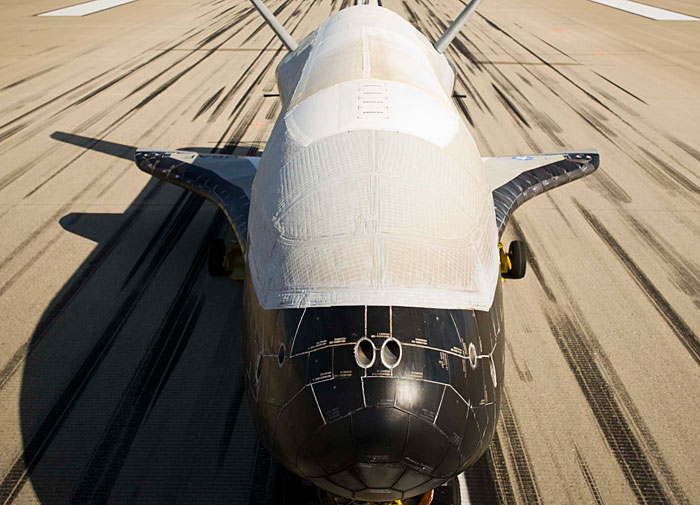


Images credit The Boeing company and Space.com Credit: AIAA/Grantz/Boeing http://www.space.com/13230-secretive-37b-space-plane-future-astronauts.html
If it’s not possible to perform a lifting body aerodynamic deceleration we would dock a SpaceX Dragon to the aft of the Sierra Nevada Dream Chaser to perform aerobraking at Venus. We need to model torquing and strain issues in the docking tunnel.Dragon would need an ADAPT aerodynamic decelerator to prevent reentry plasma’s from damaging Dream Chaser wing structures.
last image on the right is the proposed Boeing X37C a human crew vehicle, we would re purpose it for uncrewed Venus missions.
conceivably science mission directorate funding of Dream Chaser together with commercial crew completes the dream chaser business case. Many of these ideas apply to earth observation missions as well,to include weather and earth sciences.
National Academy’s decadal survey requires science gaols and instruments to achieve these goals.
Exploration_Technology_Plan_12_13
hunter_Venus workshop presentation fin b 1121-1100-LImaye-Cutts
THE BUSINESS CASE
We recover our costs by selling science data to NASA as an anchor tenant another space agency’s and by selling space on the spacecraft as a science “hosted payload” We hope for synergies between human rated flight systems and deep space flight systems,Dragon and Dream Chaser re-purposed as unmanned deep space science explorers enables robust deep space avionics to flow back into human crew systems and human rated avionics to benefit unmanned deep space systems.
According to the above paper ,”The probe will enter using aerodynamic braking to slow from 22 km/s at entry interface” In our case we propose to slow the entire two Dragon capsule flight system with an inflatable aerodynamic decelerater attached to the Dragon TPS system.We need to model this with modified ADOPT-Vital mission design study.
Uranus Dragon probe and orbiter
One or both Dragon capsules perform a subsequent EDL some days or weeks after aerodynamic deceleration,the SpaceX Trunk remains as science and telecommunications orbiter.
issues and trade space, developement costs of a small fission reactor, mass production of balloon probes and zonds,we will need to replace SpaceX avionics for all deep space missions,we need to modal two spaceX Dragons docked to one another during launch and aerodynamic deceleration.Can the small fission reactor radiator dump heat into a pressurized capsule to warm the spacecraft?
Narrow-angle camera (NAC)
2. UV imaging spectrograph
3. Mid-IF thermal detector
4. Plasma Instrument #1
5. Plasma Instrument #2
6. USO
(Probe)
7. USO
8. Nephelometer
study the costs of producing 5 flight sets of each of the above instruments
one each for a Jupiter,Saturn,Uranus,Neptune mission plus flight spares.In the case of the probes,Green Dragon should be able to carry multiple probes. notionally we see three probes per flight so we would want to cost engineer 15 probes.
Next we would need to cost engineer 5 flight sets of the Decadal study small fission reactor(FPS) including R & D.Our original idea was to modal the FPS radiator inside a Dragon capsule pressure vessel with a HeXe atmosphere! The purpose to warm the spacecraft in the outer solar system.FPS radiater at 4 Meters length and 4.5 Meters circumference is too large to fit with in the Dragon pressure vessel.
Wide Angle Camera (WAC) Analogy to LORRI [JHU/APL] LORRI (New Horizons)
Visible/Near-IR Mapping Spectrometer
NICM III System-Level Parametric Model–Optical
RALPH (New Horizons)
Magnetometer Analogy [NICM III, JHU/APL] MESSENGER MAG
Magnetometer Boom Vendor prices [MESSENGER, RBSP cost
data]
Cassini boom
cost engineer 5 flight sets each of the above instruments.
This concept needs a SEP stage,this stage could be housed in an additional Dragon trunk and would be powered by the FPS.Pushing the mass of a two capsule flight system calls for an asteroid retrieval sized SEP stage.
BUSINESS CASE
we aim to please the decadal survey and the customer NASA,we hope to win a finalist study Grant from a Discovery AO, if not selected we would attempt to fly a commercial data sales business model.
We recover our costs by selling science data to NASA as an anchor tenant another space agency’s and by selling space on the spacecraft as a science “hosted payload”
Titan Dragon lander and Titan orbit rendezvous(TOR)
The recent fly by of Titan by Cassini occurs at a flyby velocity of 5.8 Kilometers per second, well with in the Dragon Earth orbit reentry speeds.
Dragon TPS should able to handle EDL at Titan from Saturn Orbit.In this concept Dragon does a Titan EDL and splash down,we need to modal Dragon mass and buoyancy on a LCH4 sea.
Dragon deploys smaller surface and submersibles patterned after existing proposals such as Time and TSSM. Extensive mass manufacture of balloon probes from Yellow Dragon could bring down science instruments costs.
Its important to note
THE BUSINESS CASE
We recover our costs by selling science data to NASA as an anchor tenant and other space agency’s and by selling space on the spacecraft as a science “hosted payload”
TSSM_Joint Summary Report_Public Version_090120 (1)
07_Titan Montgolfiere Balloon Analysis and Design Using CFD_J. Hall
09_Buoyancy Estimation of a Titan Aerostat_G. Dorrington
A Titan site!
http://www.titanexploration.com/
update 17 June 2014;
It’s important to note that recent advances in commercial crew have brought advances to the SpaceX Dragon capsule that could have implications to non crewed planetary missions,automated docking for one,this would allow for a TOR or Titan orbit rendezvous . Dragon could EDL the surface of Titan and bring along deploy-able instruments and a Titan ascent vehicle. Since we are using a two Dragon capsule flight system to areobrake at Titan a Dragon remains in Titan orbit to TOR with the ascent vehicle with a sample return.perhaps with ISRU the Dragon Titan lander could make it back into orbit?
 Yellow Dragon, a mission to repurpose existing ideas into new ideas