
Hypothesis; cells from multiple species should be able to grow together in cellular agriculture bioreactors to create novel products & Cellular Agriculture and its applicability to solar system exploration
In a previous post, we suggested that companies that are pioneering vegetable protein products could join together with cellular agriculture. vegetable protein scaffolds could be used to mimic shark fins and the scaffold would then be populated by shark fin cells these, however, could be mixed with other animal cells.
Shark fin Salman Chimera soup
The company that makes vegetable protein based shrimp, for example, could build a scaffold for shark fin then populate the scaffold with a mix of shark fin cells and salmon cells
Shark fin scallop chimera
Bone provides important physical qualities to meat during cooking and curing so we need to find ways to vascularize and produce bone tissue during the cellular agriculture process
Perhaps the genes that express for Teratoma cancers that produce cancers with bone and teeth could be tamed to do this?
The bones themselves are important for the production of broths and soups. Secondly, the production of skin is important in roast birds and in Asian dishes.
Some of the characteristics of Teratomas are from cellular and tissue interactions within the organism so how these genes would interact in cell culture and vats would be informing
After Blue Origins reaches a capitalized value $40 to $50 Billion you could have a Leveraged ESOP purchase Blue Origin from Jeff Bezos and the purchase price payable to Mr. Bezos could be reinvested back into Blue Origins.Mr. Bezos would send the $40 Billion cash purchase of Blue Origins back to the company in the form of a massive contract for inner solar system capitalization
ESOP’s have been used to do acquisitions in this way
Future earnings pay off the Leveraged ESOP debt
Most ESOP owned firms are managed by the original owners as an ESOP is an ERISA regulated Pension plan
Insight- II The international Mars Alluvial fan explorer ( IMAFE ) & ITAFE The International Titan Alluvial fan explorer
Hypothesis; Build a copy of the INsight lander which itself is a near copy of the Mars polar lander and run a NASA AO to determine through MEPAG candidate Alluvial fans to use the INsight drill to collect thermal and seismic data on a Mars eluvial fan and its underlying basement strata.
This concept could be developed by a self-described NASA HQ internship that Dr. Green tells me about where the PI could be Eleanor Rappolee and Jeremy Rapp.Dr. Green tells OPAG that they can write your own job description/internship to develop an idea at NASA HQ as graduate students and early carrier postdocs
We have radar altimeter data of the polar ice caps layers do we have this type of data for Martian alluvial fans? data such as this would tell us with stratigraphy if martian alluvial fans are catastrophic or formed over time? An Insight-II mission would give us ground truth
Dr Green and I at OPAG Atlanta discussed that this is a great way to build on your civil service pension and retiree health benefits and that it encourages diversity! Doing this also is a recruiting tool for NASA to keep interns as the carrier workers. I discussed with Dr green that federal service was “portable” IE USGS is also federal service.
Titan Eluvial fans? I think those might show strata and deposition(particle grades) by Methane flow that would tell us about past Titan seasonality through time. This would require a new lender but the principle of the drill and its thermal and seismic sensors would be the same. This drill would need to go through the NASA cold tech research process. The principal investigators would need to write grants to go visit the French!
Use the concrete and steel decommissioning waste as a jetty and artificial reef
Southern California Edison shares the cost of decommission savings with the coastal commission in the same manner as oil rigs to reef savings. The reef is essentially paid for with NRC decommission trust funds
http://www.bioone.org/doi/abs/10.2112/SI59-028.1
A1612002-SCE- Neal, Worden-Testimony SCE-03
adopt_findings4SONGS_mitigation_reef_design020608
Mark Page page@lifesci.ucsb.edu
This project is paid for and authorized under the US constitution as a state militia expenditure and establishes a state-funded unit that is hoped would draw federal funding
We also propose using the state initiative and referendum for voter approval
The state of California shall purchase 10 BFR/BFS vehicles over a 15 year period to serve as military transport for Earth Point to Point logistics and to encourage the rebirth of California aerospace industry
The State of California would pioneer Earth point to point transport from a California Air National Guard facility
Polar orbits from California align very well with Diego Garcia and the Middle East. Earth point to point transport means that the BFR could be used to crew up Reserve MSC Ro-Ro ships in Diego Garcia within a day and have those ships underway within 24 hours. Deployment of union hall and MARAD sailors aboard BFR means approved coast guard training courses as a part of the RAC/STCW required courses.
Large numbers of California Airmen and other military personnel would become astronauts providing a competitive advantage to the state
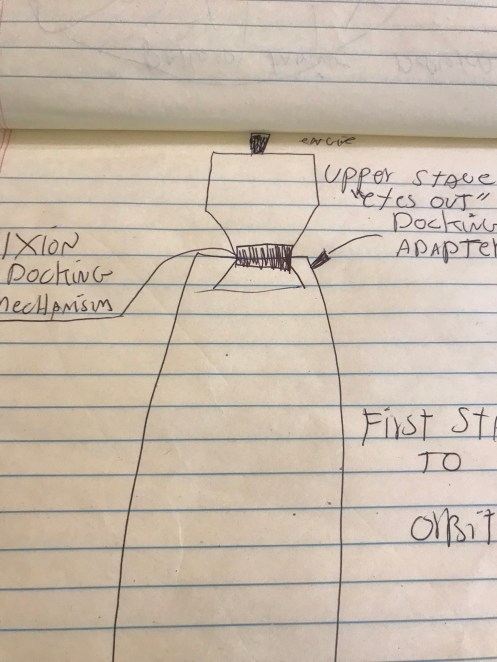
upper stage docked to first stage
The upper stage does not do a suborbital DT & E instead at launch the upper stage foreword dome is docked to the first stage inside a payload adapter/cradle with the upper stage engine facing up inside the payload fairing ( “eyes out”)
After MECO the stack flips and the upper stage wet mass propels the now dry mass first stage to orbit for refurbishment as habitat


Utilizes the SLS SRB with A Blue Origin First stage with a Dry lab and docking mechanisms and First stage wet lab brought to LEO
Would the Mass of the SLS CBC allow for a safe balancing with the New Glenn to get the New Glenn first stage to orbit?
This idea is most likely overkill I posted a newer version instead that suggests smaller SRM that fit modified Landing legs attach points.SLS SRB would be a total New Glenn redesign when really what we are after is selling used New Glenn launchers as space stations.
The more economical and engineering New Glenn with SRM is here New Glenn first stage space station with SRM,s at landing legs attach points
SLS first stage almost makes it into orbit so we propose an audacious plan to perform a Transposition, docking, and extraction maneuver between the upper stage and its first stage! The upper stage docks with the first stage and then fires its engine to bring the first stage to orbit.Possibly the docked stack makes to orbit.I believe SLS is in a 200 by 70 Kilometer orbit at MECO
Astronaut longterm health is not well served by small ISS/Gateway modules so we propose that the largest possible square meter per astronaut are optimally placed in LEO and then COTS process to compete for SEP and chemical to preposition these very large Wet lab space stations throughout the solar system.
SLS, Vulcan, New Glen and to a lesser extent Falcon 9 could use Transposition, docking, and extraction to use the upper stage to bring the stack to orbit.The only payload would be an Ixion type docking adapter.The Falcon 9 is the one system that has a high-value maneuvering system that might enhance docking with its upper stage to bring both to orbit.
This daring maneuver is after all suborbital DT &E!
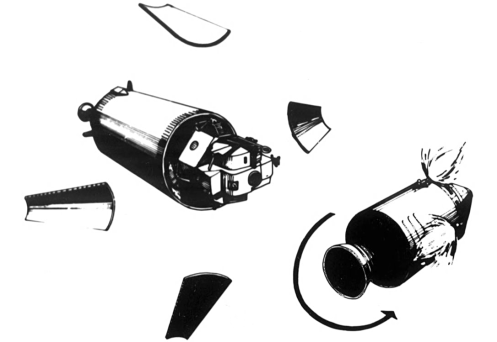
 This is incorrect! we are docking with the first stage and transporting it somewhere.This result would be both first stage and upper stage in LEO but this could a part of the distributed lift idea for the upper stage.
EDIT 26 April 2018
I have learning disabilities so let me try to think things out
We need to know the dry mass of the first stage at MECO the first stage is now are payload, Tory Bruno tells us on Twitter that first stage dry mass is 5 to 7 pounds to each pound of payload
Dry mass of the first stage at what kilometers per second? What is our shortfall to orbit? let’s do this with each first stage as wet lab candidate
Ariane 6
At MECO kilometers per second/dry mass of Ariane first stage/ wet mass of second stage and ISP of the second stage over the combined mass of both over the dry mass of first and second stage at MECO 2 of the first stage
We write another post advocating first stages as wet lab space stations by launching them without payloads and with SRB’s to get them to orbit.
In the case of the ULA Vulcan vehicle, it might have the ability to loft itself into orbit with no payload. In the case of ULA this would have to be a new vehicle since it is not reused. Cryogenic Methane makes for the Vulcan first stage space station an attractive option to habitual volume.
In the case of New Glenn even more so the New Glenn does not use SRB however, so its thought the landing legs attach points could be modified for SRB attach points? The New Glenn would need a modest payload and that would be the proposed IXION docking port.IXION is the ULA Nanoracks proposal to repurpose a Centaur upper stage as a habitat. The BFR, New Glenn, and Vulcan launchers all offer very roomy propellent tanks as wet lab habitats.
SpaceX Falcon 9 is less attractive due to its narrow and long claustrophobic propellent tanks as a space station wet lab, however, it might be useful as storage.
 Yellow Dragon, a mission to repurpose existing ideas into new ideas