
suggestions to the 30 June SBAG meeting and to the FAST committee,
Boulders that show image evidence of having rolled downhill might inform us of having lost any connection or cohesiveness to the surface. I wrote that a Boulder could be frozen,sticky(stuck) or cohesion with the surface.The speaker and moderator used the term( fill this in) and the term(fill this in) to describe a boulder made of rubble that might not survive a retrieval attempt or the trip to Distant Lunar orbit.I wrote to the SBAG moderator who asked the question to the speaker my thoughts that a boulder that has rolled downhill in a gravity well has proven it self worthy of retrieval, the moderator suggested that in a micro gravity environment this might be less so. A rolling rock might make for a primary target for a retrieval mission.A boulder that has rolled downhill might have better cohesive structure to be manipulated during retrieval!
The speaker seemed to me when he answered my question not to have considered this idea in his teams work or in his presentation.I have pondered this and I am thinking that the speakers team is only thinking of small asteroids! Deimos and Phobos might be in deep enough gravity fields that you might find rolling rocks?
So that’s it, our hypothesis is that rolling rocks are the best candidates for retrieval based on a greater suitability to remove from the surface and importantly less propellant to loft the retrieved sample from the surface.We would like to submit this as a bases for being accepted onto the FAST volunteer commitee
Rolling Rock beer could donate money to science by flying their logo on the launch vehicle?The Band The Rolling Stones could involve along with beer in public out reach.MERLIN,PANDORA and PADME could be precursor missions for a Deimos and Phobos ARM boulder retrieval mission.In most scenarios the missions would overlap so the precursor mission could image and provide navigation to the ARM. Cubesats such as NEO Scout could also provide support in a joint missions.
We propose new policy here that mimics the ARM funding mechanism.The Human space directorate needs to know Human SKG such as the radiation levels solar and cosmic at proposed human landing site on both martian moons therefore Merlin and the other Discovery AO could be funded from the human spaceflight directorate as well as the science mission directorate. We could fly two Mars moons missions with joint funding, Merlin is the lander so it could fly the radiation experiment(RAD) to the proposed human crewed martian moon crater
http://msl-scicorner.jpl.nasa.gov/Instruments/RAD/
This Discovery AO will have runners up and a final winner , if none be mars missions then My idea that several mars moon missions be flown that also carry RAD
EDIT
This is a study of ARM close proximity operations, we think this would be enenced by close proimty operations with a nearby operational Pandora mission.
ARM close proximity operations


We think ARM should be discussed at the mid decade Decadal survey to discuss the idea that ARM should really retrieve a boulder from Phobos or Deimos
EDIT 27 December 2015 , a ARRM derived Phobos sample return,
ARRM derived Phobos sample return
Steven Rappolee: Do any of these moons have any imaged boulders that have moved or rolled downhill?
————- (06/30/2015 13:47) ————-
Steven Rappolee: Merlin as ARM precursor mission
————- (06/30/2015 13:50) ————-
Steven Rappolee: landing in a crater would provide important radiation data for human missions
Arianespace Adeline as a SSME/EELV recovery system
Air Force RFP for engine and launch vehicle requires any system developed be available to all users so an American Ariane with a Adeline as a SSME/EELV recovery system would have to be manufactured here in the United States.Manufacturing a Vulcan engine assembly sounds expensive and the 16 SSME’s already exists.
Arianespace would be using an american reusable engine to launch national security payloads from California and Florida.The Launcher could be manufactured in Mobile Alabama but I would suggest a factory along the great lakes to attract the needed attention from a new state’s congressional delegation
Ariane 7
This Ariane 7 would need SRB’s and these would need to be American made as well or there would need to be a Ariane 7 Heavy with three cores.
This idea requires that the Air Force order RS-25’s and swaps them for SSME’s with NASA as suggested here; https://yellowdragonblog.com/2015/06/17/synergism-with-an-air-force-and-nasa-methane-gell-rs-25/
Late last summer I made an agreement with a Native American tribe here in Michigan to obtain some fish guts from Great Lakes caught Salmon.This group sells their fish at the Flint farmers market every Saterday.The Company is called the Fresh lake Whitefish Company The nature of the offal was from Great Lakes salmon and I noticed that Salmon have very large liver equal in size to that of chicken liver.I thought that this iron rich organ might be a product in it self that might have economic value.It would be interesting to test them for toxins as compared to the rest of the fish? They had a light liver taste and I thought it would make for a fantastic pate.I also thought that the liver did not belong in the fish sauce experiment.
I did not macerated the guts just mixed them with salt but I failed to measure the salt going into each Mason Jar and I ran out of salt so some jars received more salt others less, This experiment needs to be repeated this summer with better controls.One Mason Jar today has preserved fish guts(did not ferment) the others within days started to ferment putting off visible bubbles.Salt kills single cell organisms except for the Arcea bacteria genus. Every few days I removed the lids to remove buildup of pressure and noticed no smell, this a sign of the absence of single cell organisms from the bacteria kingdom.
The experiment with the Salmon Guts needs a small-scale repeat but a new experiment need to be conducted using only guts from Whitefish, Perch and Trout possibly walleye.I am going to ask the fresh lake folks if they would be willing to provide fish guts separated by species to me for a follow-up experiment this summer.In Asia different species of fish and squid produce differing flavors much like wine from different soils.
Fish guts and fishing vessel by catch is a underutilized resource that is dumped overboard that could be used for a human value added food product, pioneering a local fish sauce enterprise could benefit my disabled veteran owned business as well as my native american fisheries partners.I propose that the both of us write a USDA SBIR grant to study this idea next year.The USDA SBIR partners would be the Flint farmers market test kitchen, Fresh lake whitefish company and Terrestrial and Cislunar exploration technologies, a veteran owned concern.
Here is the great Lakes fishing trade group
http://www.greatlakeswhitefish.com/
And here is the USDA county agricultural agents fish at farmers market flyer
This might be an important resource to do a USDA SBIR and to learn how a fish sauce product would be regulated and labeled.
This group did a fish sauce taste test(Our daily Brine)
https://ourdailybrine.com/fish-sauce-taste-test/
Another fish sauce taste test!
compare this to the color of my fish sauce in mason jars below
<iframe width=”560″ height=”315″ src=”https://www.youtube.com/embed/uVsrDorW0C8″ frameborder=”0″ allowfullscreen>
The making of Red Boat Fish sauce
This Youtube takes us on a tour of a Vietnamese Fish Sauce factory
The making of Japanese fish sauce made from Squid intestines!
Blis makes Bourbon barrel fish sauce from Red Boat fish sauce
http://blisgourmet.com/collections/fish-sauce
EDIT
I have discovered Filipino Bagoong!
Notice the red/orange fluid in Bagoong is called Patis(fish sauce) but the solid is also used( see my Mason jars below) So the brown solids floating on top of my Mason jars might be a product?
Shotsuro 塩魚汁
Another fermented fish product
We could ferment our local fish offal here in Michigan in fruit brandy barrows?
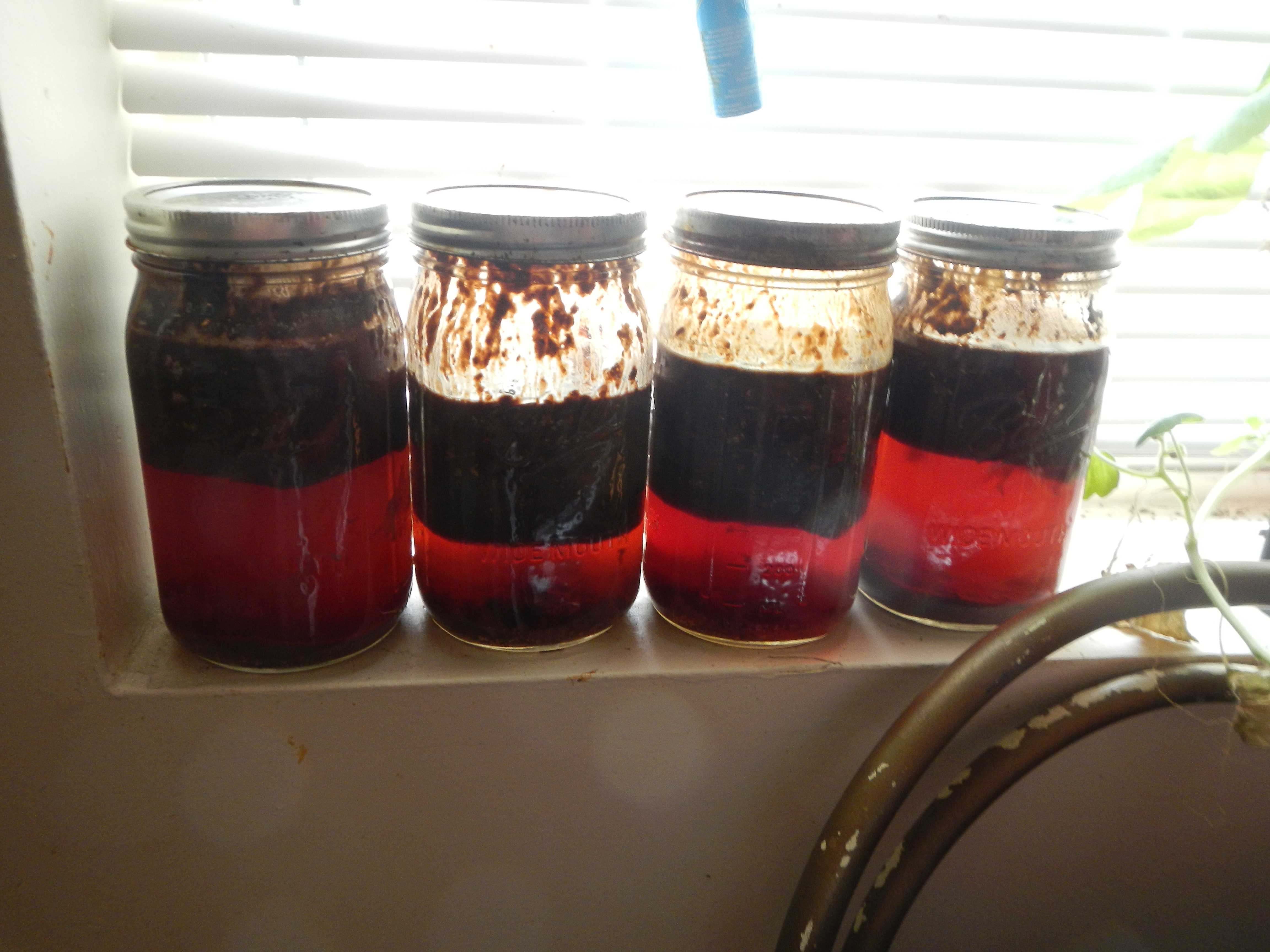
These images are from May 2015 of my mason Jar salmon fish guts that are about a year old!
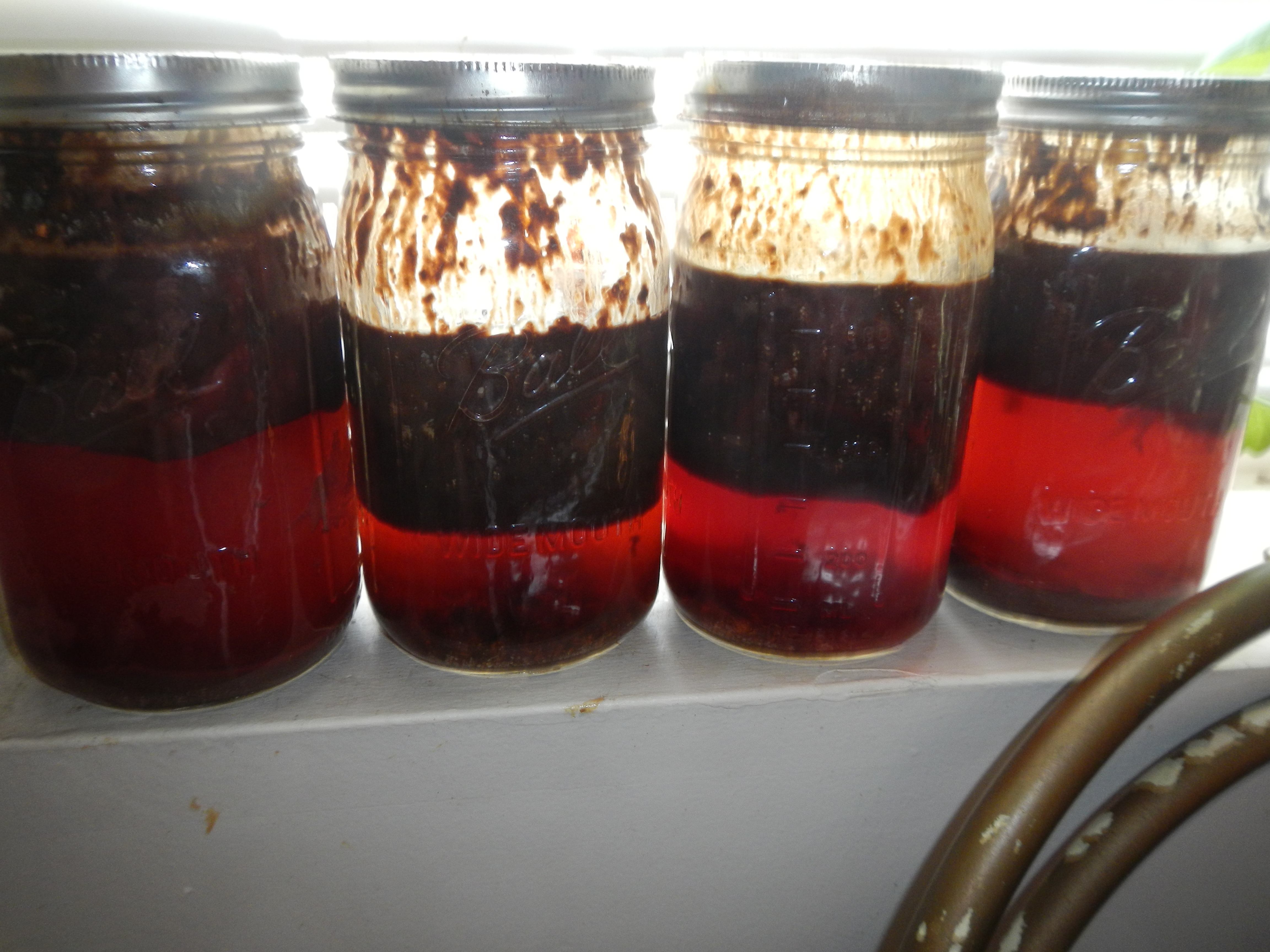
Notice the deep red/orange of the fluid that has separated out from the Protein
These images are from August 2014 fresh fish guts with salt 1 day old
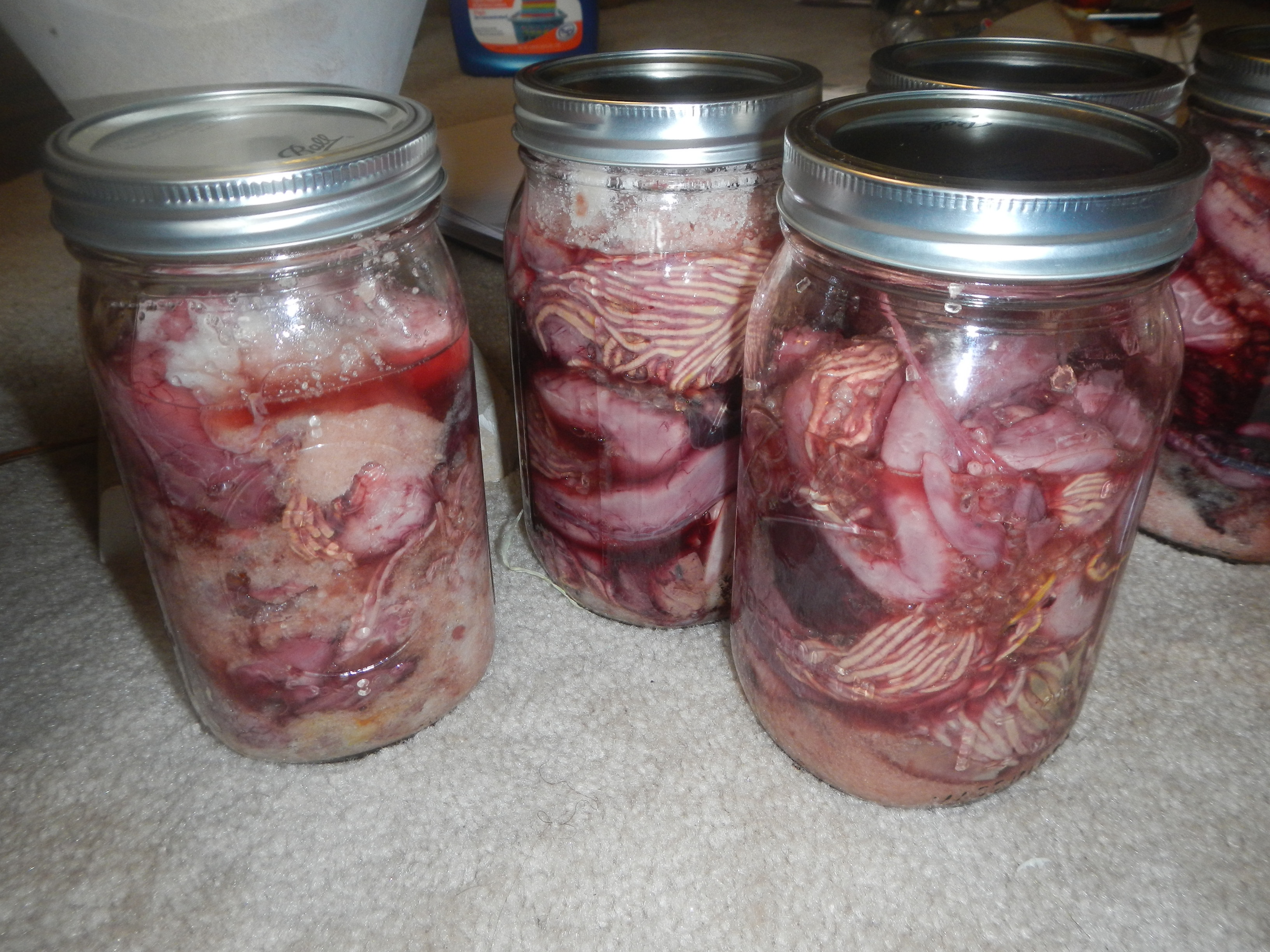
A few Jars appear to have more salt than the others
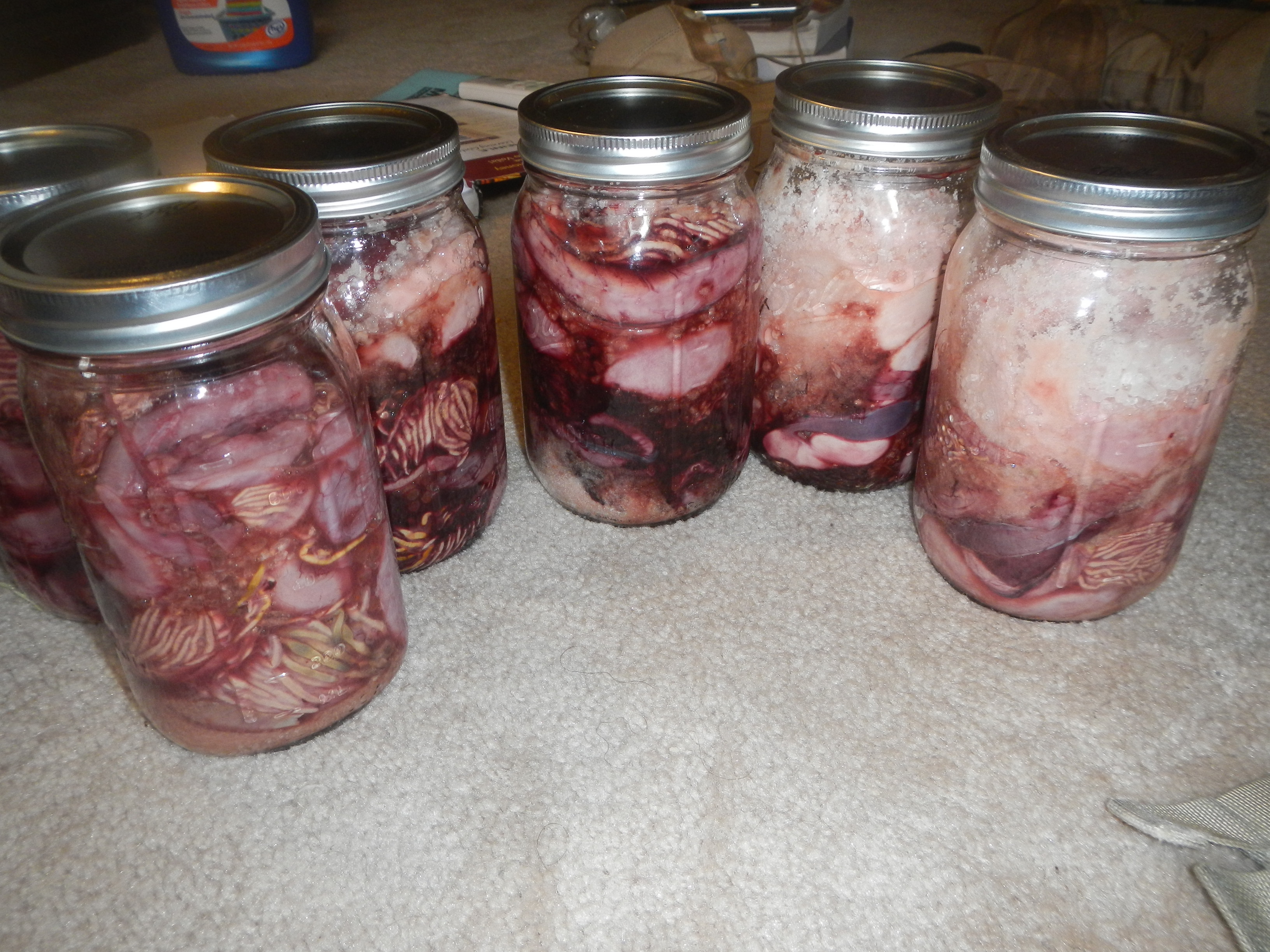
These photos are of less successful mason jars I believe is do to excessive salt in the jar with preserved fish guts, the other two mason jars have mostly macerated proteins and little orange/red fluid
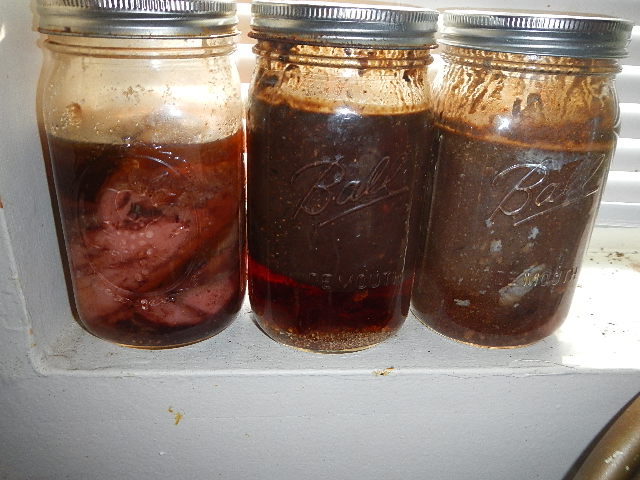
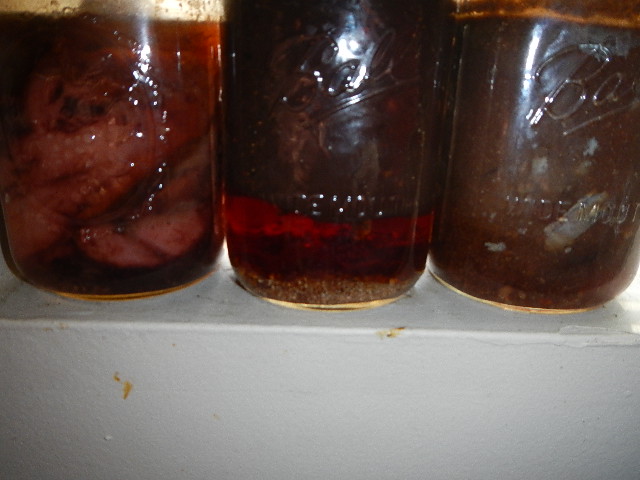
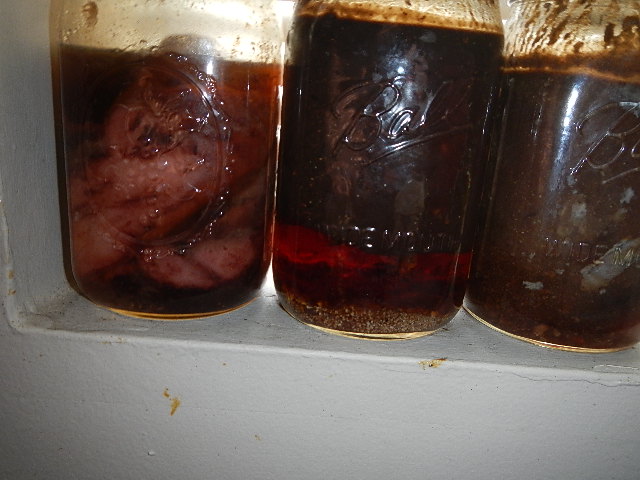
Fifteen strains of red-pigmented, strictly aerobic, coccoid, extremely halophilic archaea were isolated from fish sauce, perhaps this explains the red/orange color of fish sauce?
http://www.ncbi.nlm.nih.gov/pubmed/17911282
http://www.ncbi.nlm.nih.gov/pubmed/20207809
http://www.idosi.org/wasj/wasj8(6)10/15.pdf
The Salty Sisters, woman in Halophilies
http://journal.frontiersin.org/article/10.3389/fmicb.2014.00192/full
http://journal.frontiersin.org/article/10.3389/fmicb.2013.00315/abstract
https://tspace.library.utoronto.ca/bitstream/1807/36826/1/cc09009.pdf
Possibly a Kickstarter campaign could fund hiring a SBIR grant writer?
Air Force contracts for 16 RS-25 expendable engines and transfers( loans?) them to NASA, NASA “owes” the Air Force for these engines.These are flown on the first 3 to 4 SLS flights.The air force is owed engines that have higher molar mass engines ( hydrocarbon)
NASA agrees to transfer(loans?) the 17 SSME’s to the Air Force
The Air Force agrees to fund the R&D for recovering the SSME engines after each flight, these engines are worth recovering!
The Air Force Runs SSME on EELV with a 5% to 10% Methane gel( does it need modification?)
http://www.grc.nasa.gov/WWW/Fuels-And-Space-Propellants/GELLED.htm
Production engines for both agencies are incrementally evolved to a higher methane gel mix
NASA owes the Air Force so NASA needs a Methane gell CBC for the SLS so the Air Force agrees to look for a sweet spot between CBC and EELV commonality also NASA must replace the Air Forces SSME’s as they were out.This means the Air Force EELV must be human rated!
The SSME is already human rated
The Air Force and NASA will cost engineer the cost savings of SSME/EELV to see how many flights a recovered SSME would produce over years, assume SpaceX and ULA have won a percentage of flights.Cost engineering should be done by NASA, The Air Force, and an independent third party. SSME’s are reusable and with 16 flight sets the Air Force with recovery could see at 10 flights per engine X 2 engines per launch vehicle(3 for a heavy)yields a result of 160 flights divided by 2 equals 80 flights.Refurbishment costs of each Air Force SSME would have to be researched by cost engineers.We are talking about opportunity costs here versus delayed expenses (SSME refurbishment VS AF not having to pay for a new engine R&D)
If this SSME/RS-25 CBC as an EELV is too large even for the biggest NRO payloads then the Air Force agrees to the idea of co-manifesting NASA or commercial payloads ( each CBC would have two to three engines) The two engine SSME EELV would make for the better launcher with some Methane gel Molar mass.Two engines make for a better recovery option.
NASA and the ESA agree to explore the joint development of the winged engine recovery option as long as the air force requirement is meet on this being sold to everyone.This would be built in the United States and Europe.(a US Adeline)
In Light of recent events in the Ukraine involving Russia and the European Union acknowledging the European aspirations of the Ukrainian people we the nations of the world should help the government of the Ukraine achieve membership in the scientific and engineering intergovernmental organizations there.
We could use redirected foreign military assistance funds to help Ukraine pay for memberships in the European Southern observatory and the European Space agency as suggested in this post,
and here,
Think of the statue outside the United Nations HQ ,”swords to plowshares” In this case its bullets to spacecraft
Ukraine belongs here in the near future,( as does the other EU eastern partnership states)
http://www.esa.int/About_Us/Welcome_to_ESA/European_Cooperating_States
http://www.eso.org/public/about-eso/memberstates/
It would mean a Ukraine launch vehicle lofting from the ESA spaceport in South America
It means we could design a Ariane V launch vehicle with Xenit CBC’s? Or perhaps a Zenit with European engines and VEGA CBC’s?
Con ops; SLS lofts EUS and Skylab-II to dock with ISS. EUS uses Xenon as a ullage gas and SEP propellant.The Skylab-II is pressurized with Xenon.The stack docks with ISS and brings a cargo of Cryogenic Xenon to pressurize the ISS. EUS performs a chemical burn to depletion and then switches over to SEP operations.The chemical burn is needed to Loft the ISS/Skylab-II stack above the atmosphere so that the SEP does not have to fight atmospheric drag from the ISS solar arrays.Shortening the travel time through the Van Allen belts is useful too.The EUS then becomes a wet lab habitat.
The ISS pressurized volume of 916 m3 would hold 6 tons of Xenon ( 916 x 5.9 Kg = 5,404 Kg)
The Skylab-II would hold 495 cubic meters of Xenon (495 x 5.9 Kg = 2,920 Kg)
EUS Xenon ullage gases would represent at chemical burn out and with a 495 M3 Hydrogen tank ( 495 x 5.9 = 2,920 Kg)
EUS Xenon Ullage gases for the LOX tank?
This is 11 tons of gases Xenon short of the 30 tons needed However the 30 tons of xenon needed from LEO does not account for the EUS burn
ISS weight (420 tons)
Skylab-II weight 37,300 Kg (37 tons)
EUS dry mass weight 11,853 Kg (12 tons)
http://www.aqua-calc.com/calculate/volume-to-weight
EDIT Dec 2017
These two papers discuss LH2/LO2 zero boil-off stage lofted to LEO to a 10 day HEO by a SEP system through the van Allen belts over two years (80 to 100 tons)
I think 100 tons payload to a 10 day HEO is less than 1/4th the weight Of Xenon propellant (20 tons?) or 3.1Km/s
So 469 tons x .20% is 93 Mt of Xenon we argue mass fractions savings could be had by cryogenic Xenon tanks
The chief technologist out at NASA Ames told me last year that a SBIR small business owned by a non engineer could hire an engineer to do the work so here is my idea ( think I will blog about it today)
Hire Help to write a good kickstarter page
using kickstarter to raise funds to hire a SBIR grant writer
Grant writer might be your engineer as well
Kickstarter phase two raises matching funds to that of the SBIR funds
convince DOD/contractors that internship programs can lead to Mentor protegé subcontractor and not just an employment pathway.
(IE employee to subcontractor)
Intern is an employee, graduates from intern to mentor protege program and from here goes to transform to a subcontractor
Veterans internship to mentor Protege program, VIMPP gawwd another acronym
https://www.youtube.com/watch?v=Xyozdd5z50M
The research above shows that Argon is miscible in Liquid Methane at .49 But I believed the mixed liquid Argon with Liquid Methane, So Argon as a ullage gas for liquid Methane might be a lower process that also might form ices(?)
The master ullage gas study done by a PHd student
https://rappolee.files.wordpress.com/2015/06/20100026018.pdf

Some references to self pressurized LH2 and LCH4 propellants which is what ULA and SpaceX are working on, No references to noble gasses being used for good reason helium is light.
So its still an unknown as to how Noble ullages gas would react to chemical propellant
The SSME as the engine for the Air Force RFP ?
(A)(1) Cons; would be more expensive than The Delta-!V by far! unless….
(B)(1)This engine exists now and using an extent engine saves the Air force the 7 years and most of the $ 1 billion cost.(B)(2) SSME costs $70 Million each so 14 could be bought for $1 Billion however a block buy should be able to bring this price down(B)(3)An EELV with 2 SSME’s could possibly serve as a SLS CBC since 4 SSME’s are equivalent in thrust to one SRB however this means you would need 4 CBC’s!(B)(4) In the alternative you could have a SSME powered EELV with 4 SSME’s each but this monster would not any sense(B)(5) Three cores strapped to one another.with 6 SSME’s would be more expensive than Delta-IV it could be argued except that the air force along with NASA could do bulk purchases with use on the SLS and SLS CBC and an EELV
(C)(1) For the cost of the proposed Air Force RFP and a bulk buy for what would have been R&D costs you could perhaps purchase 20 engines(C)(2) The Air force RFP requests that the contractor engage in a private public partnership so Aerojet could fund the launch vehicle that would host the engine, this could be in partnership with a third party.(C)(3) If the engines are never used by the Air force they could be sold to NASA for SLS and the private/public partnership recovers its money, this works best if NASA agrees to mix some of these new engines with used engines from the shuttle program on the first three SLS missions.NASA would pay some money up front in order to gain from the block buy.An early NASA purchase would also increase the likely hood of a larger block buy to lower the per unit costs and that would increase the chances that an EELV would beat the Delta-IV in price.
(D)(1) The EELV and the EELV heavy would be human rated!(D)(2) The RS-25 could be incrementally evolvable to our proposed methane gell duel fuel RS-25
Methane SSME study
and the Methane gell Paper
http://www.grc.nasa.gov/WWW/Fuels-And-Space-Propellants/GELLED.htm
EDIT 15:07 Hours
In the alternative Aerojet could comply with an Air Force RFP request for a private/public partnership by simply manufacturing its own white tail RS-25 to match an Air Force buy, this could be with an NASA agreement to fly them sooner rather than later and a third party partner funds the launch vehicle for the EELV.The existing RS-25/SSME test articles could used for integration studies for a clean sheet launcher and the NASA test stands could study propellent flow characteristics
If the Air Force stays with SpaceX and a future Vulcan vehicles and occasionally flies with the RS-25 vehicle then it would be important to design this EELV if possible as a SLS CBC. It might be possible to with this industrial policy to make it economical to be flying three engines and three launch vehicles and this leverages the NASA SLS need for a CBC to better inform Air Force purchases decisions.NASA on the other hand by agreeing to fly a mix of old and new engines on the first 3 SLS vehicles enables aerojet and the air force to leverage funds to develop the launch vehicles
Buying 28 new engines over 4 to 5 years and halving the price would be another method for aerojet to contribute skin in the game with the understanding that RS-25 to RS-25E becomes an incremental effort that NASA planned to fund anyhow.A mass purchase of an incrementally evolved RS-25 to RS-25E could be done with the existing SLS funding and the Air Force benefits to from the lower cost RS-25E. with a production run and the SSME test article engine we could also test fire low levels of methane/LNG gelled in LH2, I believe one of the test stands has been modified to handle this type of propellent but we would need to add this capability to the SSME test stand.In the end all or most of the air force SSME’s might be sold to NASA but the RS-25E could find its way on a launch vehicle with greater frequency as it comes on line for Air Force use
ORBITAL AND AEROJET FOR BEO COMMERCIAL CARGO?
In regards to a third party launch vehicle intregreter orbital comes to mind! We do not suggest giving up the new russian engine or Antares but a RS-25 powered vehicle could get commercial cargo (Cygnus) to a Lagrange point space station.orbital and aerojet could sell this as another means to NASA to lower RS-25 unit costs to SLS.I am researching this right now but the SSME’s are very light,The RS-25E will be a bit heavier but this would a great quality to have for engine recovery via helicopter in air retrieval!
http://aviationweek.com/space/aerojet-rocketdyne-cranking-expendable-ssme
https://www.youtube.com/watch?v=iGsRS-s7Rv0
https://www.youtube.com/embed/iGsRS-s7Rv0“>
 Yellow Dragon, a mission to repurpose existing ideas into new ideas